
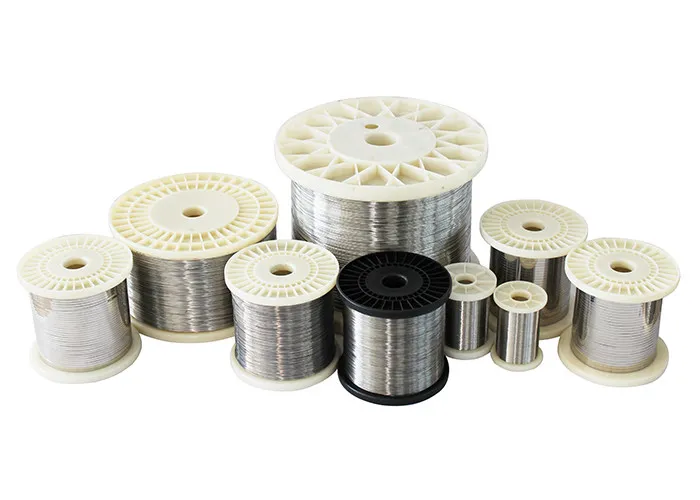
Pure nickel strip and nickel-plated steel strip are both used in battery connection and electrical assembly applications, but they are not equivalent materials.
The two products differ in electrical conductivity, magnetic behavior, mechanical strength, corrosion behavior, resistance-welding characteristics, thermal performance, and cost. Selecting the wrong material can affect connection resistance, heat generation, weld consistency, long-term reliability, and manufacturing efficiency.
Pure nickel products such as Nickel 200 and Nickel 201 are available in strip, foil, wire, bar, and other forms for selected industrial and battery-related applications. Nickel-plated steel, by contrast, combines a steel substrate with a nickel surface layer.
Quick answer: Pure nickel is often selected when electrical conductivity, corrosion resistance, nickel-alloy compatibility, and predictable material chemistry are important. Nickel-plated steel may be considered when higher mechanical strength, magnetic response, or cost-related requirements are important. The correct choice depends on current, weld method, strip thickness, battery chemistry, connection design, and required service life.
1. What Is Pure Nickel Strip?
Pure nickel strip is manufactured primarily from commercially pure nickel, commonly including grades such as Nickel 200 and Nickel 201, depending on the application and specification.
These materials are valued for combinations of:
- Electrical conductivity
- Corrosion resistance in selected environments
- Thermal conductivity
- Ductility
- Formability
- Weldability
- Stable nickel-based chemistry
- Low magnetic permeability in selected product conditions
Pure nickel strip is commonly considered for:
- Battery tabs and interconnections
- Battery pack assembly
- Electrical contacts
- Industrial electrical components
- Chemical equipment components
- Precision metal parts
- Selected heating and electrical applications
The exact suitability depends on thickness, purity, surface condition, and the electrical and mechanical design.
2. What Is Nickel-Plated Steel Strip?
Nickel-plated steel consists of a steel substrate covered by a nickel coating. The steel provides mechanical strength, while the nickel surface may improve corrosion resistance, solderability, contact behavior, or surface compatibility.
Its performance depends on:
- Steel substrate grade
- Nickel coating thickness
- Coating uniformity
- Surface preparation
- Plating process
- Adhesion
- Base-metal thickness
- Weld configuration
Nickel-plated steel can be useful where the application needs a combination of structural strength and a nickel surface. However, its electrical and welding behavior is not the same as solid nickel.
3. Electrical Conductivity: Why Material Chemistry Matters
Electrical resistance is a key consideration in battery interconnections because unwanted resistance produces heat and voltage loss.
The resistance of a strip is influenced by:
Where:
- (R) = electrical resistance
- (rho) = electrical resistivity
- (L) = current path length
- (A) = cross-sectional area
This means resistance depends on both material resistivity and strip geometry.
Pure nickel
Pure nickel generally offers higher electrical conductivity than steel. Its conductivity may be beneficial in applications where the connection design requires lower resistance within the available cross-sectional area.
Nickel-plated steel
The steel substrate has higher electrical resistivity than pure nickel. Although the nickel coating contributes to surface properties, the complete current path depends on the substrate, coating, contact geometry, and connection design.
Important practical point
A nickel-plated surface does not automatically make a steel strip electrically equivalent to solid nickel. Engineers should evaluate the complete current path rather than judging the product only by its surface appearance.
4. Resistance Welding Considerations
Battery strips are often joined using resistance spot welding or related processes. The welding behavior depends on:
- Material resistivity
- Strip thickness
- Surface condition
- Electrode geometry
- Welding current
- Welding time
- Electrode force
- Heat dissipation
- Substrate composition
- Coating thickness
Pure nickel welding
Pure nickel strip is widely used in battery spot-welding applications because it offers a nickel-compatible surface and can be processed using suitable resistance-welding parameters.
However, weld quality still depends on:
- Strip thickness
- Battery terminal material
- Electrode condition
- Welding equipment
- Surface cleanliness
- Current and pulse settings
Nickel-plated steel welding
Nickel-plated steel may require different welding parameters because the steel substrate and nickel coating affect electrical resistance and heat generation.
The coating can also influence:
- Weld nugget formation
- Electrode wear
- Contact resistance
- Surface consistency
- Weld spatter
- Process repeatability
A welding parameter that works for pure nickel should not automatically be transferred to nickel-plated steel.
5. Corrosion Resistance and Long-Term Reliability
Battery connections may be exposed to:
- Humidity
- Condensation
- Electrolyte contamination
- Temperature cycling
- Mechanical vibration
- Salt-containing environments
- Chemical residues
- Internal battery gases or by-products
Pure nickel
Pure nickel offers corrosion resistance in many selected environments and may be useful where a solid nickel material is preferred.
Nickel-plated steel
Nickel-plated steel relies partly on the integrity of its coating. If the coating is damaged, porous, poorly adhered, or penetrated during forming or welding, the underlying steel may become exposed.
This does not mean nickel-plated steel is unsuitable. It means the coating system and application environment must be evaluated as part of the material selection.
6. Mechanical Strength and Formability
The mechanical properties of the substrate and strip condition affect:
- Bending
- Forming
- Vibration resistance
- Tab stability
- Assembly handling
- Fatigue performance
- Dimensional retention
Pure nickel
Pure nickel is known for ductility and formability in appropriate grades and conditions. It may be suitable where the strip must be bent, shaped, or welded without excessive cracking.
Nickel-plated steel
Steel generally provides higher strength and stiffness than pure nickel, depending on the specific grades and conditions. This may be useful where the connection requires structural support or resistance to deformation.
However, higher strength may also affect forming behavior and the risk of coating damage during bending.
7. Thermal Performance and Heat Dissipation
Battery connections must manage heat generated by current flow and resistance at electrical joints.
The thermal behavior of a strip depends on:
- Electrical resistivity
- Thermal conductivity
- Strip dimensions
- Contact resistance
- Welding quality
- Current level
- Duty cycle
- Ambient temperature
- Cooling conditions
A material with lower electrical resistance may reduce resistive heating in the strip, but the total thermal behavior of the battery assembly also depends on contact points, welds, busbars, cell configuration, and current distribution.
Material selection should therefore be based on the complete electrical and thermal design rather than one isolated property.
8. Pure Nickel vs Nickel-Plated Steel: Comparison Table
This table is a general engineering comparison. Actual performance depends on the specific product specification and application.
9. How to Choose the Right Battery Strip
Step 1: Define the electrical requirements
Specify:
- Continuous current
- Peak current
- Voltage
- Current pulse duration
- Allowable voltage drop
- Maximum allowable temperature rise
- Connection length
- Strip width and thickness
Step 2: Define the welding process
Identify:
- Resistance spot welding or another joining method
- Welding equipment
- Electrode type
- Welding current range
- Required weld strength
- Number of weld points
- Production volume
Step 3: Check battery and terminal compatibility
Consider:
- Battery cell type
- Terminal material
- Cell casing
- Surface treatment
- Electrochemical environment
- Required connection resistance
Step 4: Confirm mechanical requirements
Review:
- Required bending radius
- Tab shape
- Vibration exposure
- Assembly stress
- Fatigue requirements
- Dimensional tolerances
Step 5: Verify material and surface specifications
For pure nickel, confirm:
- Grade, such as Nickel 200 or Nickel 201
- Nickel purity or chemical composition
- Thickness and width
- Temper or delivery condition
- Surface finish
- Dimensional tolerance
For nickel-plated steel, confirm:
- Steel substrate grade
- Nickel coating thickness
- Coating uniformity
- Adhesion
- Surface finish
- Welding compatibility
10. Why Strip Thickness and Width Matter
Even when the material grade is correct, the wrong dimensions can cause performance problems.
Thickness
Thickness affects:
- Electrical resistance
- Heat generation
- Mechanical strength
- Weld energy requirements
- Flexibility
- Current-carrying capability
Width
Width affects:
- Cross-sectional area
- Current distribution
- Heat dissipation
- Connection geometry
- Available welding area
Length
Longer current paths generally increase electrical resistance. In compact battery assemblies, connection layout can therefore be as important as the strip material itself.
A supplier inquiry should specify dimensions clearly rather than requesting only “battery nickel strip.”
11. Common Purchasing Mistakes
Mistake 1: Assuming all silver-colored strips are pure nickel
Appearance does not confirm material chemistry. Solid nickel and nickel-plated steel may look similar.
Mistake 2: Choosing only by price
The lowest material price may not produce the lowest total cost if welding failures, high resistance, coating damage, or rework occur.
Mistake 3: Ignoring coating thickness
For nickel-plated steel, coating thickness and uniformity can be important to corrosion, welding, and surface performance.
Mistake 4: Using the same welding settings for different materials
Pure nickel and nickel-plated steel can require different process parameters.
Mistake 5: Neglecting traceability
For battery and electrical applications, consistent material chemistry and dimensional control are important for production repeatability.
12. Frequently Asked Questions
Is pure nickel better than nickel-plated steel for battery connections?
Neither material is universally better. Pure nickel and nickel-plated steel have different electrical, mechanical, welding, and corrosion characteristics. The correct choice depends on the battery design and application requirements.
Is pure nickel more conductive than nickel-plated steel?
Pure nickel generally has higher electrical conductivity than steel. In nickel-plated steel, the steel substrate remains an important part of the current path.
Can nickel-plated steel be spot welded?
Yes, nickel-plated steel can be used in suitable resistance-welding applications, but welding parameters must be developed for the specific substrate, coating, thickness, and joint configuration.
What are Nickel 200 and Nickel 201?
Nickel 200 and Nickel 201 are commercially pure nickel grades used in selected industrial, electrical, chemical, and battery-related applications. The appropriate grade depends on the service environment and specification.
What should I specify when buying pure nickel battery strip?
Specify the nickel grade, purity or chemical composition, thickness, width, length, temper, surface finish, dimensional tolerance, quantity, and intended welding or electrical application.
Conclusion
Pure nickel and nickel-plated steel are both useful materials for battery and electrical connections, but their performance depends on fundamentally different constructions. Pure nickel provides solid nickel chemistry throughout the strip, while nickel-plated steel combines a steel substrate with a nickel surface.
The best selection should be based on electrical resistance, welding process, corrosion exposure, mechanical requirements, dimensions, and production consistency. A clear material specification helps prevent confusion between visually similar products.
Looking for pure nickel strip, nickel foil, or nickel wire for battery and industrial applications? Contact Alloysfactory to discuss grade, dimensions, surface condition, and custom material requirements.
Contact Alloysfactory
Company: Danyang Jiaxin New Materials Technology Co., Ltd.
Website: https://www.alloysfactory.com/
Email: sales@alloysfactory.com
Phone / WhatsApp: +86 180 5277 8977
Address: Building 10, Fuqian Xingzuo, Development Zone, Danyang City, Jiangsu Province, China
Thank you very much for writing to us. Please leave your message and contact information, we will reply to you within 24 hours.